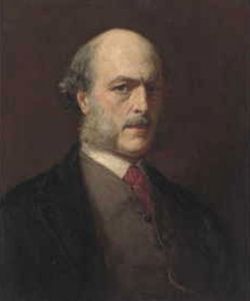
 Sir William Frederick Pollock, 2nd Baronet (April 3, 1815 – December 24, 1888), led a life deeply embedded in the legal, literary, and intellectual elite of Victorian
Britain.
Sir William Frederick Pollock, 2nd Baronet (April 3, 1815 – December 24, 1888), led a life deeply embedded in the legal, literary, and intellectual elite of Victorian
Britain.Queer Places:
University of Cambridge, 4 Mill Ln, Cambridge CB2 1RZ
59 Montagu Square, London W1H 2LS, UK
Kensal Green Cemetery, Harrow Rd, London W10 4RA, United Kingdom
Sir William Frederick Pollock, 2nd Baronet (April 3, 1815 – December 24, 1888), led a life deeply embedded in the legal, literary, and intellectual elite of Victorian
Britain.
Born on 3 April 1815 in London as the second, but first surviving, son of Sir Jonathan Frederick Pollock, 1st Baronet—a distinguished barrister, Member of Parliament, and Lord Chief Baron of the Exchequer—and his first wife, Frances Rivers, he was destined for a prominent public path.
His early education was shaped under private tutors before he attended St Paul’s School in London. He subsequently entered Trinity College, Cambridge, where he matriculated in April 1832, was admitted as a scholar in 1835, and graduated with a BA in 1836 (proceeding to an MA in 1840). During his undergraduate years, he achieved significant recognition within student life, serving as the President of the Cambridge Union Society in 1836. More notably, Pollock was a member of the elite intellectual society known as the Cambridge Apostles. Though of junior standing to Alfred Tennyson, Pollock belonged to that celebrated inner circle whose deep intellectual bonds and debates were immortalized by Tennyson in "In Memoriam" (specifically section lxxxve). Regarding any potential LGBTQ+ historical links, while the Cambridge Apostles fostered an environment of intense, passionate homosocial and romantic intellectual intimacy among young Victorian men—similar to groups associated with figures like Arthur Henry Hallam—Pollock's personal life followed a conventional Victorian trajectory. No explicit historical or archival evidence points to same-sex romantic or sexual relationships; rather, his documented romantic life culminated in a traditional marriage, and any homoerotic undercurrents remain strictly confined to the general homosocial ethos of the Apostles' intellectual culture.
Following in his father's formidable legal footsteps, Pollock was admitted to the Inner Temple in January 1833 and called to the Bar on 26 January 1838. He joined the Northern Circuit, where he served for several years as a revising barrister. His administrative legal career flourished when he was appointed a Master of the Court of Exchequer in 1846. Decades later, in 1874, he was named to the ancient and prestigious office of Queen's Remembrancer, alongside serving as Senior Master from 1874 until 1886. When the courts of law and equity were fused under the Supreme Court of Judicature Act in 1875, the office of Queen's Remembrancer was formally annexed to the senior mastership. He held these dual responsibilities until his retirement and resignation in September 1886. Upon his father's death on 23 August 1870, he succeeded to the family baronetcy.
Beyond the courtroom, Pollock was widely celebrated as a man of liberal culture, refined intellect, and rare social charm. He maintained a vast network of friendships across the worlds of literature, science, and art, which he documented in his entertaining autobiography, Personal Remembrances, published in 1887. His artistic and literary engagements were deep; he was a close friend and executor of the eminent actor William Charles Macready, subsequently editing Macready’s two-volume Reminiscences in 1876. Furthermore, Pollock showcased his scholarly versatility by translating Dante's Divine Comedy into closely literal blank verse, published in 1854 with fine illustrations after Flaxman and George Scharf. His likeness was captured for posterity in a portrait painted by the Royal Academician W. W. Ouless.
On 30 March 1844, Pollock married Juliet Anna Maria Catherine Creed, daughter of the Reverend Henry Creed, vicar of Corse, Gloucestershire. The couple raised a family that carried forward their intellectual and professional legacy. Their eldest son, Sir Frederick Pollock, 3rd Baronet, achieved immense academic distinction as the Corpus Professor of Jurisprudence at Oxford and a renowned legal historian, continuing the family's Cambridge Apostle legacy. Their second son, Walter Herries Pollock, established himself as a notable writer and critic, and their youngest son, Maurice Emilius Pollock, was born in 1857.
Sir William Frederick Pollock spent his final years residing in Montague Square, London, and passed away there on 24 December 1888 at the age of 73. He was laid to rest at Kensal Green Cemetery in West London.
References:
 The Cambridge Apostles, 1820-1914: Liberalism, Imagination, and Friendship in British Intellectual and Professional Life 1st Edition by W.C. Lubenow |
Other references:
Support this project
This website is a passion project researched, developed, and funded entirely by me. If you find the content valuable and would like to help support the ongoing research and hosting costs, any contribution is deeply appreciated.
Thank you for keeping this independent resource alive!
My books on Amazon: Elisa Rolle's books